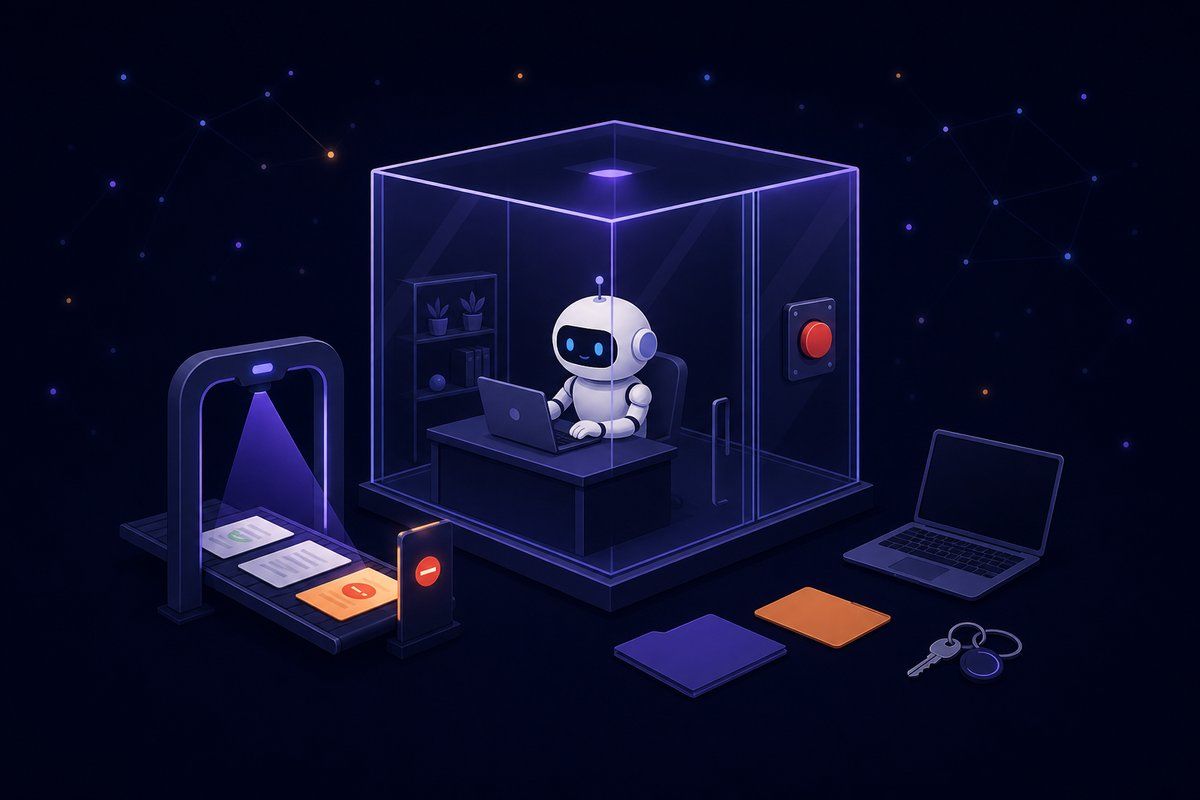
We used to think picking an AI tool was like picking a coffee machine. You choose one, you learn its buttons, and you stop thinking about it.
It is not like that. Your AI provider can change its prices, its rules, its leadership and its product in a single week, and you will find out the same way everyone else does: by reading the news, or by noticing that Tuesday's work looks different from Monday's.
Our stance is simple. Use one AI provider by habit if you like, but never by dependence. The difference is whether you could switch by Friday if you had to.
People call this vendor lock-in. For a small team it is simpler than it sounds: it is the cost of leaving.
One week of news is a reminder
A weekly business newsletter covering 9 to 15 November 2026 reads like a list of reasons not to get comfortable. In seven days it reported that OpenAI launched business profiles inside ChatGPT and a wallet that lets agents complete purchases once a person approves them. It reported that Anthropic released new models and tools, including one that joins your video meetings.
We are not saying any provider is about to fail. We are saying that companies moving at this speed will keep changing things, including what they charge you. The same newsletter gives owners one piece of practical advice: keep a second AI provider available in case pricing changes. We think that is the right instinct, and it deserves a method.
Where AI vendor lock-in hides
Most people think dependence means a contract. In practice it hides in smaller places.
In your prompts. You spent weeks tuning wording that works well with one model. Nobody wrote it down as a job description, so it only lives inside that one tool.
In your habits. Your team knows where the buttons are. Switching feels like retraining, even when the new tool is just as good.
In your data and files. The notes, documents and past conversations that make the tool useful for you sit in one account.
In your price. If a plan you rely on changes, your budget changes with it, and you have no leverage because you have no alternative. We wrote separately about how to control your team's AI spending.
A backup plan for a small team
You do not need an engineering department. You need an afternoon and four steps.
1. Write the job, not the prompt. For each task you hand to AI, write three lines: what it should produce, what good looks like, and what it must never do. This is the same idea as in our post on giving an agent a job instead of a prompt. A clear job moves between tools. A clever prompt does not.
2. Keep your material yours. Store instructions, examples and reference documents in your own files, not only inside one provider's chat history. If the account vanished tomorrow, you should lose nothing but the history.
3. Test the second provider once. Take your three most important tasks and run them on another provider. You are not looking for a winner. You are checking that the switch is possible, and noting what changes in the result. Do it now, while nothing is urgent.
4. Know your switch cost. Write one line: if we switched next week, what would break and how long would it take? If you cannot answer, that is your dependence, measured.
Cheapest is not the goal
Backup plans usually start from a price scare, so it is tempting to pick whichever model is cheapest on paper. Resist that. A model that looks cheap per word can cost more once you count retries and fixes, which we covered in our post on the real cost of the cheapest model. The aim is not to chase the lowest price. It is to keep the freedom to move when it matters.
It is also worth taking the time to match the model to the task. A small, fast model can handle routine sorting and drafting, and a stronger one can be saved for hard work. Teams that think this way find switching easier, because they never assumed one model does everything.
What this means for agents
The more work you give an AI agent, the more this matters. An agent that has a job, access to your tools and the ability to act is far harder to swap than a chat window. Satya Nadella made a related point at the DealBook Summit on 18 November: companies that refuse agents risk losing to those that accept them. The web is being reshuffled around agents, and the businesses that adapt fastest will be the ones that can change tools without drama.
That is why we think of an agent as a role you define, with limits and an owner, running on whatever model suits the task. Your role definition is the asset. The model underneath is a part you can replace.
Try this week
Pick one task you rely on AI for. Write its job in three lines. Run it once on a second provider. Write down what you noticed. It takes less than an hour, and it turns a vague worry into a plan.
If you want to see how a defined role works in practice, you can add your first agent and give it one job.
Sources
- AI Newsflash for Business Owners, "AI Newsflash, 9 to 15 November 2026", 17 November 2026 (OpenAI business profiles and wallet, Anthropic launches, the advice to keep a second AI provider)
- TechCrunch, "Satya Nadella predicts AI agents will reshuffle the economics of the web", 18 November 2026
 Ask about this article